After plants have built strong leaves and stems, every healthy garden reaches the same turning point:
the shift from growth to flowering.
This is where many gardeners make mistakes. They keep feeding nitrogen, expecting more flowers, and instead get lush foliage with disappointing blooms. Flowering is not about speed—it is about energy management inside the plant.
If nitrogen drives growth, then phosphorus and potassium decide whether a plant will flower, set fruit, and finish strong.
This article is a complete, practical compendium on fertilizers for flowering—what nutrients matter, when to apply them, and how to support vegetables, fruit plants, flowers, and ornamental shrubs using both organic and natural methods.
If you haven’t yet covered the growth phase, start here first:
👉 which fertilizer promotes plant growth
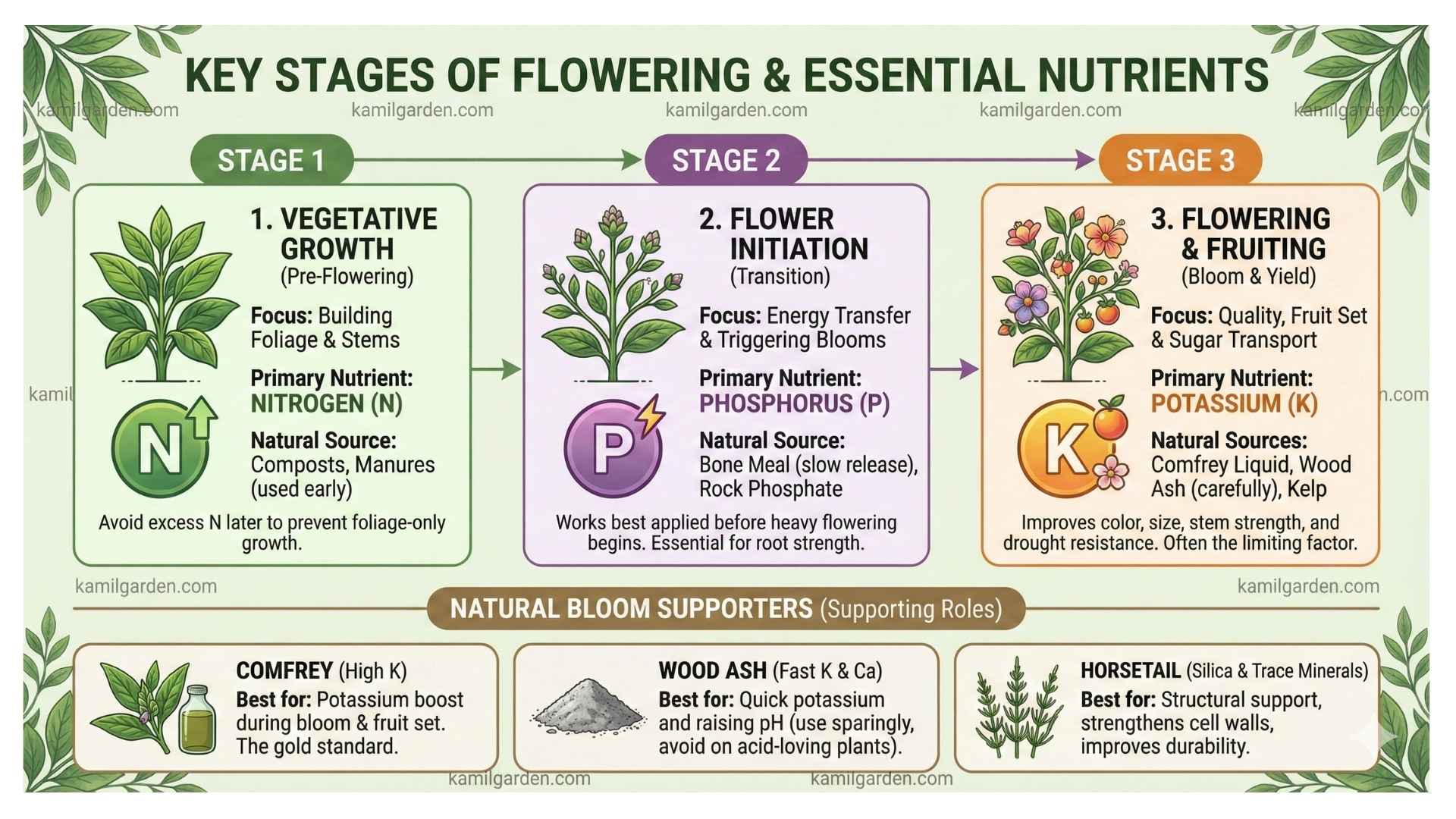
What flowering actually requires from a plant
Flowering is an energy-intensive phase. The plant must:
- move sugars efficiently,
- build reproductive tissues,
- maintain water balance,
- strengthen cell walls,
- and protect flowers from stress.
To do this, plants rely mainly on:
- Phosphorus (P) – energy transfer and flower initiation
- Potassium (K) – flower quality, fruit set, resistance, sugar transport
Nitrogen still matters, but only in small, controlled amounts. Too much nitrogen keeps the plant in vegetative mode and delays or reduces flowering.
Phosphorus – the trigger for flowering and root strength
Phosphorus is often described as the “energy nutrient.” Inside the plant, it is essential for:
- ATP production (energy transfer),
- root development,
- flower initiation,
- seed formation.
Plants deficient in phosphorus may:
- flower late or poorly,
- show stunted growth,
- develop dark or purplish leaf tones,
- drop buds prematurely.
Phosphorus is not mobile in soil, which means timing and placement matter more than sheer quantity. It works best when:
- incorporated into soil before planting,
- applied early, before heavy flowering begins.
Potassium – the backbone of blooms and fruit
If phosphorus starts the process, potassium determines the outcome.
Potassium is responsible for:
- transporting sugars to flowers and fruits,
- improving flower size and color,
- strengthening stems,
- regulating water balance,
- increasing resistance to heat, drought, and disease.
Plants lacking potassium often show:
- weak flowering,
- small or misshapen fruit,
- poor color and flavor,
- leaf edge browning on older leaves.
For flowering and fruiting crops, potassium is often the limiting factor—especially later in the season.
Natural fertilizers that support flowering (and how they differ)
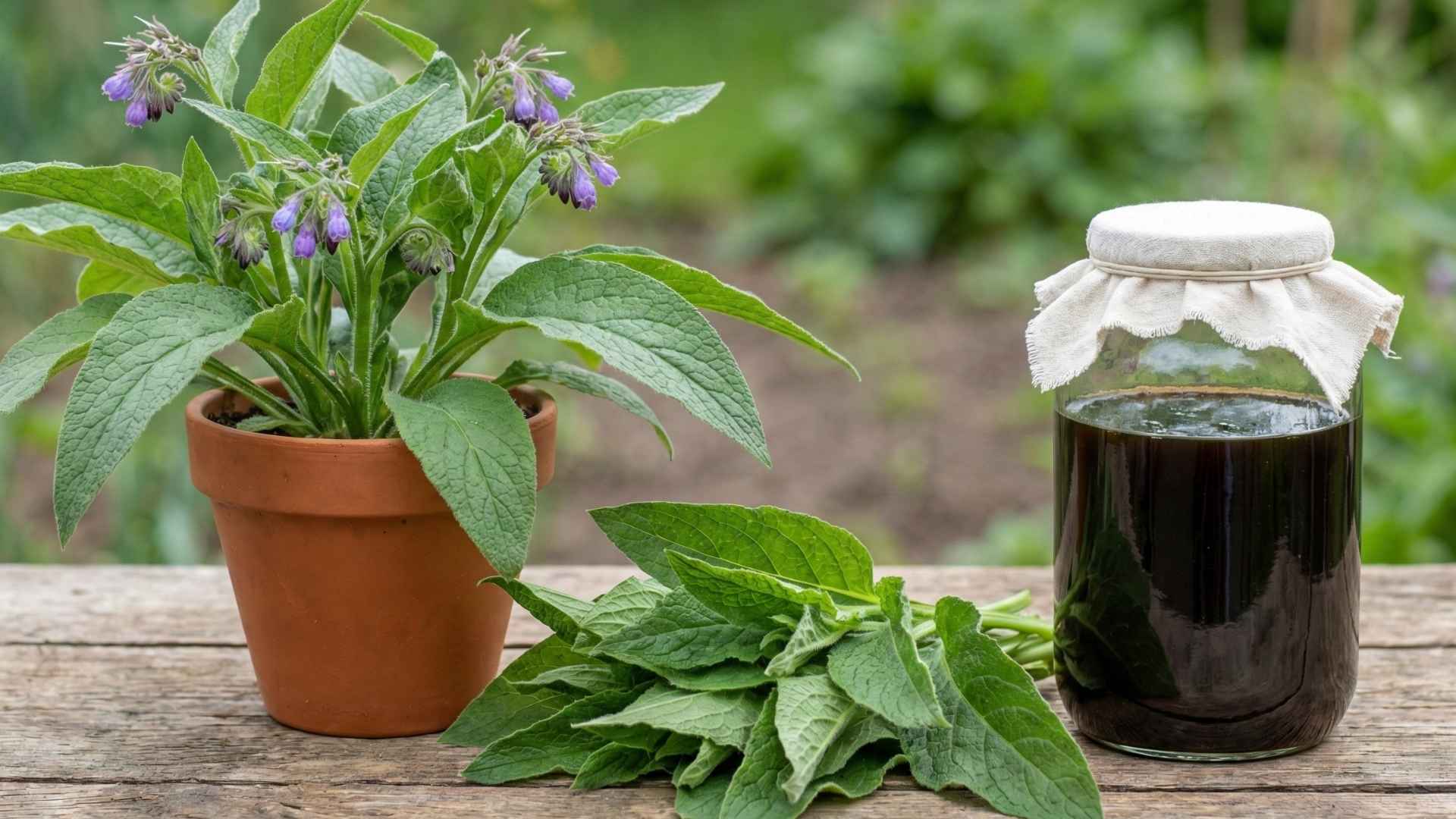
Comfrey – the gold standard for potassium
Comfrey is one of the most valuable flowering fertilizers available to gardeners.
- Common comfrey (Symphytum officinale) – rich in potassium
- Russian comfrey (Symphytum × uplandicum) – even higher potassium content, faster biomass production
That’s why Russian comfrey is often preferred for flowering and fruiting crops.
A full, detailed guide is available here:
👉 Comfrey Gold – Russian comfrey fertilizer
Comfrey fertilizer works best:
- just before flowering,
- during bud formation,
- through early fruit development.
It should not be used heavily during early vegetative growth.
Wood ash – fast potassium, use with care
Wood ash is one of the strongest natural potassium sources, but it must be handled carefully.
Benefits:
- very high potassium,
- supplies calcium,
- raises soil pH.
Risks:
- can raise pH too much,
- unsuitable for acid-loving plants,
- easy to overdose.
Best used:
- sparingly,
- on neutral to acidic soils,
- for fruit trees, berries, and flowering vegetables.
Never mix wood ash with nitrogen fertilizers.
Horsetail (Equisetum) – support, not nutrition
Horsetail is not a primary flowering fertilizer, but it plays an important supporting role.
It supplies:
- silica,
- trace minerals.
Silica strengthens cell walls, which:
- improves flower durability,
- reduces disease pressure,
- supports stems carrying heavy blooms or fruit.
Horsetail works best as:
- a foliar spray,
- a complement to potassium-rich feeding.
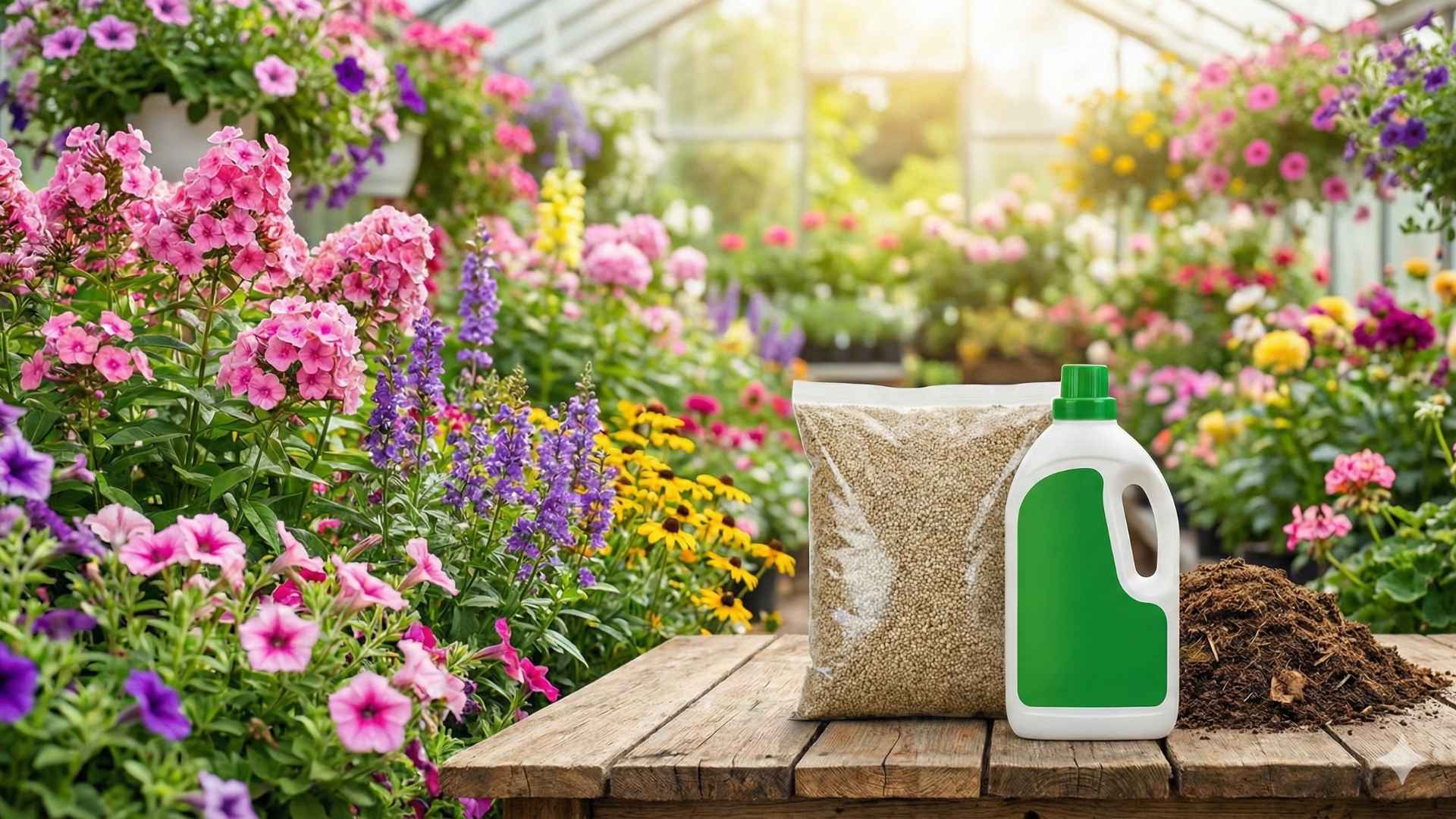
Balanced organic bloom fertilizers
Well-formulated organic bloom fertilizers often combine:
- moderate phosphorus,
- higher potassium,
- minimal nitrogen.
They are suitable for:
- ornamentals,
- flowering perennials,
- fruiting vegetables,
- container plants.
They work more slowly than mineral fertilizers but are safer and support soil health.
Matching flowering fertilizers to plant groups
Vegetables (flowering and fruiting types)
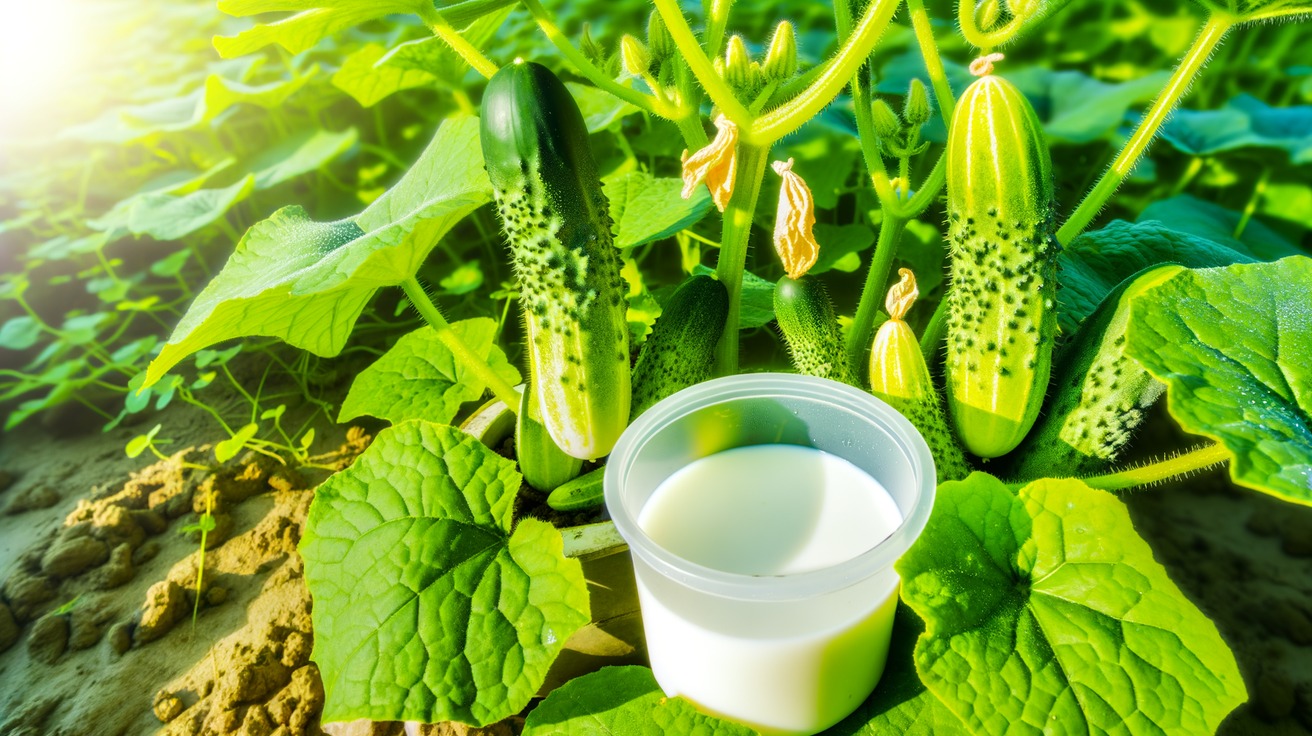
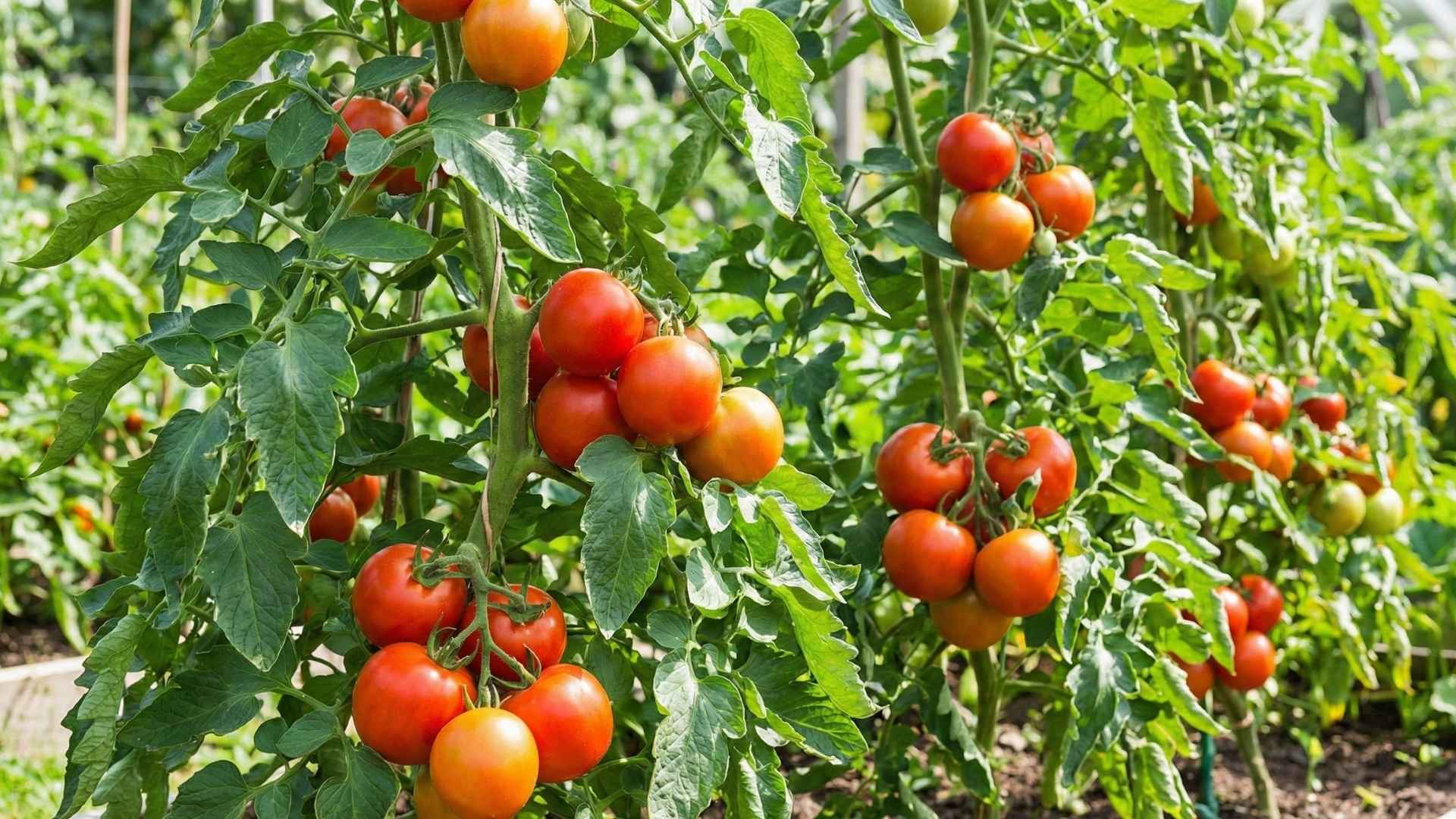
Examples: tomatoes, peppers, cucumbers, squash, beans.
Best approach:
- reduce nitrogen after early growth,
- introduce potassium-rich feeding at bud stage,
- maintain steady watering.
Overfeeding nitrogen at this stage leads to foliage-heavy plants with fewer flowers.
Fruit trees and berry bushes
Fruit plants need:
- phosphorus early (root and bud support),
- potassium during flowering and fruit set.
Avoid heavy feeding after midsummer, which can:
- delay ripening,
- reduce winter hardiness.
Comfrey fertilizer is excellent in spring and early summer for these plants.
Ornamental flowering plants
Flowers respond strongly to potassium:
- better color,
- longer bloom duration,
- stronger stems.
Nitrogen should be used early only. Once buds appear, potassium should dominate.
Shrubs and perennials
Shrubs benefit from:
- moderate phosphorus during establishment,
- potassium for flowering and stress tolerance.
Excess feeding often causes more harm than benefit.
Flowering fertilizer overview table
Tabela: Nutrients and fertilizers for flowering
| Nutrient / fertilizer | Main role | Best timing | Risk level |
|---|---|---|---|
| Phosphorus | Flower initiation, energy transfer | Pre-flowering | Low |
| Potassium | Flower quality, fruit set | Bud to fruit stage | Low–medium |
| Comfrey fertilizer | Natural potassium source | Flowering period | Low (diluted) |
| Wood ash | Fast potassium + calcium | Early flowering | High (overuse) |
| Horsetail extract | Structural support | All flowering stages | Very low |
When flowering fertilizers fail
If plants don’t flower despite correct feeding, the cause is often:
- excessive nitrogen,
- water stress,
- poor light,
- incorrect pruning,
- soil pH outside optimal range.
No fertilizer can override environmental stress.
Practical rules for feeding flowering plants
- Reduce nitrogen once buds appear
- Increase potassium gradually, not suddenly
- Feed consistently, not aggressively
- Combine soil feeding with foliar support if needed
- Stop heavy feeding late in the season
Flowering is about balance, not force.
FAQ – fertilizing for flowering
1. What nutrient is most important for flowering?
Potassium, supported by adequate phosphorus.
2. Can I force more flowers with fertilizer?
No. Fertilizer supports flowering, but light, water, and plant maturity decide the outcome.
3. Is comfrey fertilizer better than mineral bloom fertilizer?
For long-term soil health and steady results, yes.
4. When should I stop nitrogen feeding?
Once flower buds are clearly forming.
5. Can wood ash replace potassium fertilizer?
Yes, but only in small amounts and suitable soils.
6. Do flowers need phosphorus every year?
Only if soil levels are low. Excess phosphorus is unnecessary.
7. Why do plants grow leaves but no flowers?
Usually excess nitrogen or insufficient light.
8. Can I use flowering fertilizer on young plants?
Not recommended. Young plants need nitrogen first.
9. Does potassium improve fruit flavor?
Yes. It directly affects sugar transport and concentration.
10. Is horsetail a fertilizer?
No. It is a plant-strengthening supplement.
11. Can flowering fertilizers burn plants?
Mineral products can. Organic liquids are safer when diluted.
12. How often should I apply potassium-rich feeds?
Every 10–14 days during flowering, depending on plant response.
13. Are flowering fertilizers different for vegetables and flowers?
The principle is the same; dosage and timing differ.
14. Does soil pH affect flowering nutrients?
Yes. Incorrect pH can lock phosphorus and potassium.
15. What’s the biggest mistake with flowering fertilizers?
Trying to fix poor flowering with nutrients instead of fixing light, water, or excess nitrogen.
Flowering is the reward phase of gardening.
When phosphorus sets the stage and potassium carries the performance, plants don’t just bloom—they finish beautifully.
Discussion (0)
No comments yet. Be the first to start the conversation!
Leave a Reply