
A Journey of Growth: A Personal Tale of Ficus Propagation
I remember standing in my living room, staring at the lonely Ficus elastica whispering through its glossy green leaves. It reminded me of the lush, towering trees from my childhood backyard where I'd often find myself lost in the labyrinth of nature's wonders. Ficus trees, commonly known as rubber plants, held a special place in my heart. So, when a dear friend gifted me a small potted Ficus, I was overjoyed. Watching it thrive under my care brought back a flood of memories. However, the real joy came when I learned to propagate it, multiplying not just the number of plants but also the happiness they brought into my life.
Today, I invite you on a journey—a journey where we'll explore three easy and fulfilling methods to propagate Ficus: water, soil, and air layering. Each technique offers its unique charm and challenges, and in the end, you'll decide which is best for you and your plant family.
Understanding Ficus
The Magic of Ficus
The Ficus genus includes more than 850 species of trees, shrubs, and vines. These evergreen plants are native to the tropics but have found a place in homes and offices worldwide. Known for their vibrant foliage and air-purifying qualities, Ficus plants are a popular choice among plant enthusiasts.
Choosing Your Candidate
The perfect candidate for propagation is a healthy, mature Ficus with no signs of disease or pest infestation. The most commonly propagated species are Ficus elastica (Rubber Plant), Ficus benjamina (Weeping Fig), and the increasingly popular Ficus lyrata (Fiddle-Leaf Fig). Once you have your plant, it's time to choose the best propagation method.
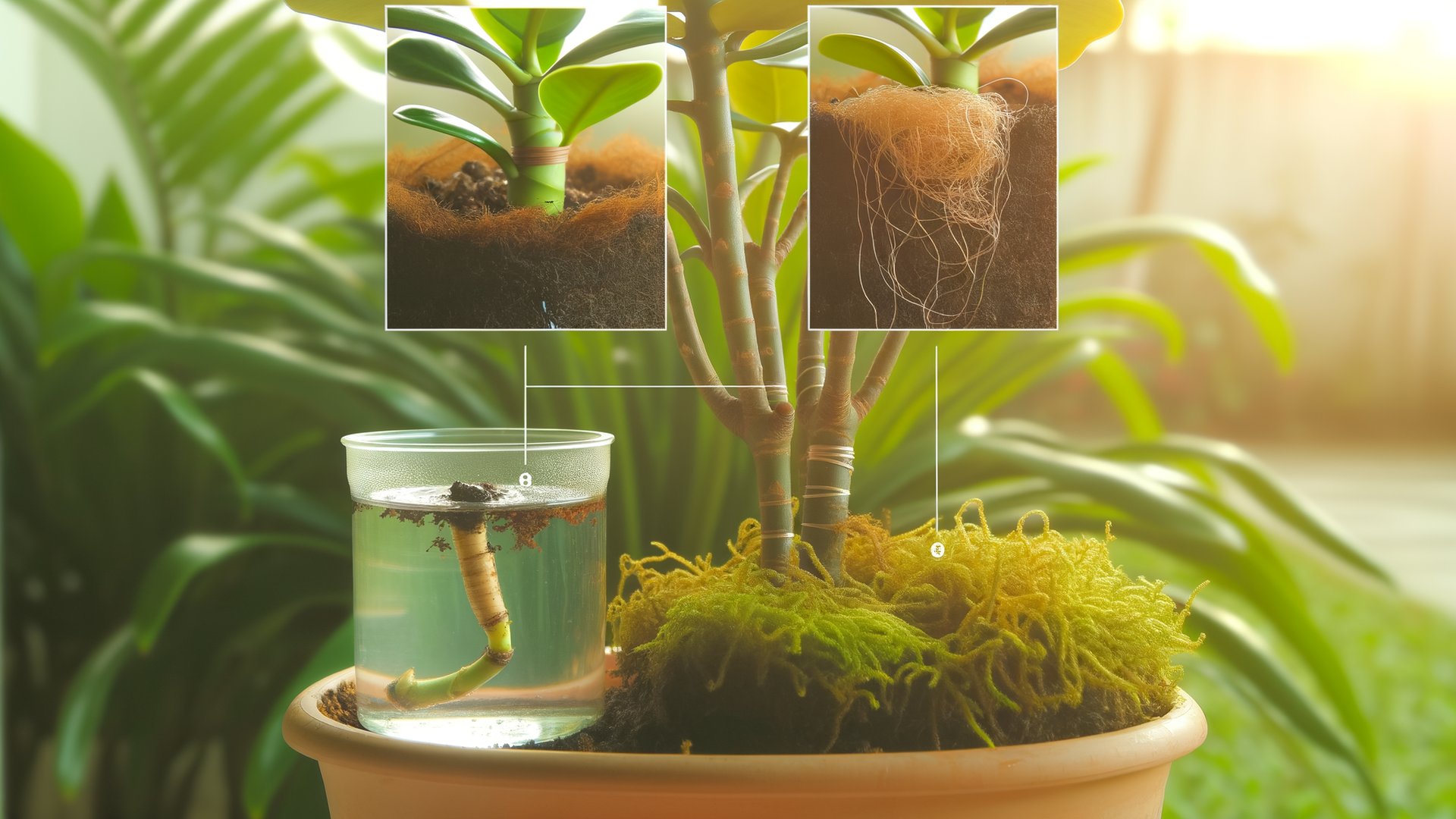
Method 1: Water Propagation
Water propagation is often the first method that comes to mind due to its simplicity and the joy of watching roots develop.
Steps for Water Propagation
-
Select a Healthy Stem: Choose a stem that is healthy and free of any blemishes or pests. It should be at least 6 inches long and have a few leaves.
-
Make the Cut: Using a sharp and sterilized knife or scissors, make a clean cut below a node (the point where leaves and roots grow from the stem).
-
Remove Lower Leaves: Remove the lower leaves, leaving only a couple of leaves at the top.
-
Prepare the Water Container: Place the cutting in a glass of water ensuring the node is submerged. Change the water every few days to prevent stagnation.
-
Wait and Watch: Place the glass in a warm area with indirect sunlight. Roots should start developing in 2-4 weeks.
-
Transplanting: Once the roots are at least an inch long, transplant the cutting into soil, ensuring the roots are covered completely.
Pros and Cons of Water Propagation
Pros:
- Visibility: You can see the roots growing, ensuring successful propagation.
- Control: Easier to monitor for contamination or decay.
Cons:
- Transition Stress: Plants can undergo shock when moved from water to soil.
Method 2: Soil Propagation
Soil propagation is perhaps the most natural method, allowing the cutting to establish roots in its final growing medium from the start.
Steps for Soil Propagation
-
Select and Cut a Healthy Stem: Follow the same initial steps of selecting and cutting as in water propagation.
-
Prepare the Soil: Use a well-draining potting soil mixture and moisten it lightly.
-
Plant the Cutting: Insert the cutting into the soil at a 45-degree angle, ensuring that at least one node is buried.
-
Create a Greenhouse Effect: Cover the pot with a plastic bag or dome to retain humidity, mimicking a greenhouse environment.
-
Monitor and Care: Place in indirect sunlight and mist occasionally. Ensure the soil remains moist but not waterlogged.
-
Growth Observation: In 4-6 weeks, check for new growth as a sign of successful propagation.
Pros and Cons of Soil Propagation
Pros:
- No Transition Shock: The plant grows directly in soil.
- Stronger Root System: Often results in a sturdier root development.
Cons:
- Hidden Process: Roots development is not visible, requiring patience and trust in the process.
Method 3: Air Layering
Air layering is a fascinating method allowing you to propagate large, woody stems that might not root through traditional cutting.
Steps for Air Layering
-
Select and Prepare the Branch: Choose a healthy, straight branch. Make a slanting cut upward one-third into the branch.
-
Encourage Rooting: Place a toothpick in the cut to keep it open and apply rooting hormone to stimulate root growth.
-
Cover with Moss: Surround the cut area with moist sphagnum moss and wrap tightly with plastic wrap to retain moisture.
-
Secure and Wait: Tape the wrap to secure it. Periodically check and keep the moss moist.
-
Cut and Plant: Roots typically develop in 8-10 weeks. Once established, cut the branch below the root section and plant in soil.
Pros and Cons of Air Layering
Pros:
- Mature Plants: Results in larger, more mature plants.
- Minimal Damage: The parent plant remains largely unaffected.
Cons:
- Time-Intensive: Takes longer compared to other methods.
- More Laborious: Requires more initial setup and monitoring.
Making the Choice: Which Method is Best for You?
Choosing the best propagation method depends on several factors, including your experience level, the specific Ficus you have, and personal preference for watching the growth process. Water propagation is great for beginners who enjoy seeing immediate results, while soil propagation offers a straightforward approach that aligns with natural growth. Air layering is your go-to method for a challenge and larger plants.
FAQs
1. Can I propagate Ficus from a single leaf?
No, Ficus cannot be propagated from a single leaf alone; a piece of stem with a node is necessary.
2. How long does it take for a Ficus cutting to root?
It usually takes around 4-8 weeks for Ficus cuttings to root, depending on conditions and method used.
3. What is the best time of year to propagate Ficus?
Spring to early summer is ideal, as the plant's growth cycle is most active.
4. Do I need rooting hormone for propagation?
While not necessary, rooting hormone can increase success rates by encouraging faster and stronger root growth.
5. How long can cuttings stay in water before planting in soil?
Cuttings can stay in water until roots are about an inch long, usually for a few weeks, before moving them to soil.
6. Why are my Ficus cuttings not rooting?
Potential reasons include low humidity, lack of indirect sunlight, or an unhealthy parent plant.
7. What type of soil is best for Ficus?
A well-draining potting mix, often supplemented with perlite or sand, is ideal for Ficus.
8. Should I change the water during water propagation?
Yes, change the water every few days to prevent bacteria growth and ensure oxygenation.
9. What should I do if the leaves turn yellow during propagation?
Check for overwatering or inadequate light, and adjust the environment accordingly.
10. Can all Ficus species be air layered?
Yes, most Ficus species can be air-layered, though success rates may vary.
Discussion (0)
No comments yet. Be the first to start the conversation!
Leave a Reply