
Every Schlumbergera owner wants the same miracle:
buds everywhere, flowers opening one after another, and a plant that keeps blooming instead of dropping buds.
For years, my grandfather had one Schlumbergera that bloomed so intensely it looked artificial. No chemicals. No fancy products. Just a quiet routine built around simple home ingredients and perfect timing.
At the time, I thought it was superstition.
Years later, after growing dozens of Christmas cacti myself, I realized something important:
👉 He was accidentally following plant physiology almost perfectly.
This article explains why that old method works, which household ingredients actually stimulate flowering, and how to use them without hurting the plant.
No myths. No copied tricks. Just real, repeatable results.
Why Schlumbergera Is So Easy to Ruin (and Hard to Make Bloom)
Schlumbergera is not a desert cactus. It’s a forest epiphyte, adapted to:
- filtered light,
- periodic moisture,
- organic matter,
- seasonal signals.
Most flowering failures come from three mistakes:
- feeding too much nitrogen,
- keeping the plant in constant growth mode,
- ignoring the plant’s natural bloom cycle.
To make Schlumbergera flower heavily, you must stop feeding it like a leafy houseplant and start supporting its reproductive phase.
That’s where the “grandfather trick” begins.
The Golden Rule of Schlumbergera Flowering
Before talking about ingredients, one rule matters more than all others:
Flowers are not created by force. They are unlocked by balance.
Schlumbergera blooms best when:
- growth slows slightly,
- nitrogen is reduced,
- potassium and phosphorus are available,
- roots are healthy but not overfed.
Any “magic fertilizer” that works follows this logic—even if the person using it doesn’t know the science behind it.
The Core Idea Behind the “Magical” Home Feed
My grandfather never said “potassium” or “phosphorus.”
He said: “You feed leaves in summer. You feed flowers in winter.”
His mixture always did three things:
- Reduced nitrogen pressure
- Supplied mild potassium and phosphorus
- Improved nutrient uptake without shocking roots
That combination is exactly what Schlumbergera needs before and during bud formation.
Home Ingredients That Truly Boost Schlumbergera Flowering
Below are safe, proven household ingredients that work when used correctly.
Not all at once.
Not all year.
Only at the right time.
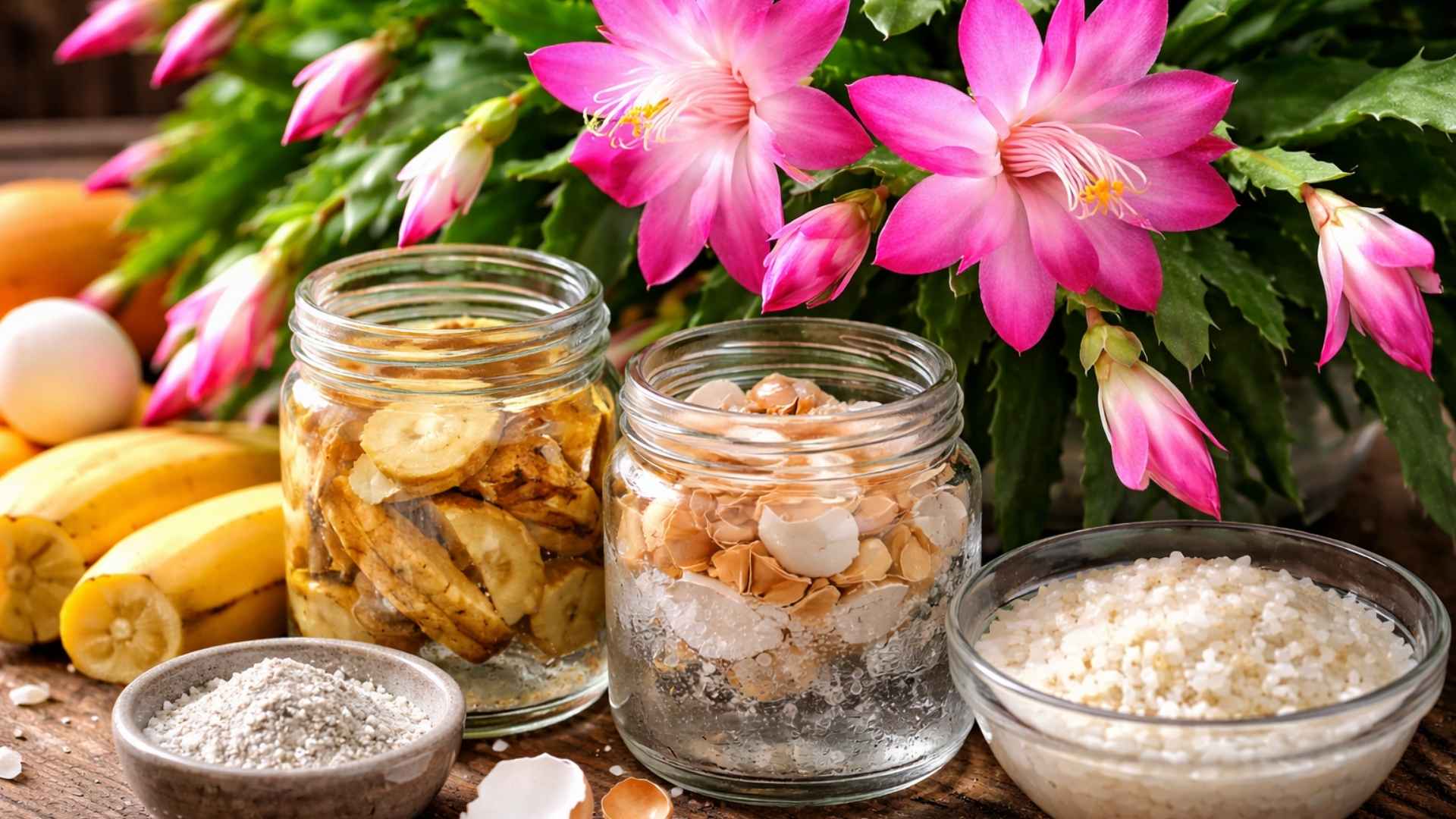
1. Banana Peel Water – Gentle Potassium Boost
Banana peels are rich in potassium, which plays a direct role in:
- bud formation,
- flower longevity,
- sugar transport inside the plant.
How to prepare:
- Soak one small banana peel in 1 liter of water for 12–24 hours.
- Strain completely.
- Dilute 1:1 with clean water.
How to use:
- Water the soil lightly.
- Use once every 3–4 weeks during the pre-bloom phase.
This feed does not force growth.
It supports flowering signals already present in the plant.
2. Eggshell Water – Calcium for Bud Stability
Bud drop is often linked to weak cell walls and unstable moisture flow.
Calcium helps stabilize tissues during bud development.
How to prepare:
- Rinse and crush clean eggshells.
- Boil in water for 10 minutes.
- Cool and strain.
How to use:
- Apply sparingly as soil water.
- Once every 6–8 weeks is enough.
This won’t create buds—but it helps keep them from falling off.
3. Wood Ash (Micro-Dose Only) – Potassium Without Nitrogen
Wood ash is powerful—and dangerous if abused.
In very small amounts, it:
- supplies potassium,
- slightly raises pH,
- discourages excess vegetative growth.
How to use safely:
- A literal pinch mixed into a liter of water.
- Stir well, let settle.
- Use only the clear solution.
Frequency: once per season, maximum.
This is not routine feeding.
This is a seasonal signal, not a fertilizer program.
4. Rice Water (Unsalted) – Microbial Support
Rice water doesn’t “feed flowers.”
It feeds soil life, which improves nutrient availability.
Rules:
- No salt.
- No spices.
- Light dilution only.
Used occasionally, it improves root-zone activity without pushing leaf growth.
When to Apply Flower-Boosting Feeds
Timing matters more than ingredients.
Best window:
- after visible buds appear,
- during bud swelling,
- early flowering phase.
Worst time:
- during active leaf growth,
- right after repotting,
- when the plant is stressed or dehydrated.
Never feed a dry Schlumbergera.
Moist soil first, feed second.
What Stops Schlumbergera From Blooming (Even With “Magic” Feeds)
Many people do everything right—except one thing.
Common bloom killers:
- excess nitrogen from all-purpose fertilizers,
- frequent repotting,
- moving the plant constantly,
- warm nights during bud formation,
- overwatering in cool conditions.
No home remedy can fix these mistakes.
Light and Temperature – The Hidden Bloom Triggers
Even the best feed won’t work if the environment is wrong.
Schlumbergera needs:
- bright, indirect light,
- cooler nights before flowering,
- stable placement (no moving the pot daily).
Many heavy bloomers flower simply because they were left alone.
The Truth About “Nonstop Blooming”
Schlumbergera does not bloom forever.
But when conditions are right, it can:
- bloom in waves,
- open flowers for weeks,
- set new buds while older flowers fade.
That’s not magic.
That’s a plant that feels safe and balanced.
Summary: Why the Old Trick Works
The “magical” home feed works because it:
- supports flowering nutrients,
- avoids nitrogen overload,
- respects plant rhythm,
- improves uptake instead of forcing growth.
That’s why it still works decades later.
FAQ – Schlumbergera Flowering at Home
1. Can Schlumbergera bloom without fertilizer at all?
Yes, if soil is healthy. Feeding only enhances potential.
2. Is banana peel water safe for indoor plants?
Yes, when diluted and used sparingly.
3. Why does my Schlumbergera drop buds?
Usually stress: temperature swings, dry roots, or excess nitrogen.
4. Can I use these feeds year-round?
No. Use only around the flowering period.
5. Does Schlumbergera need phosphorus every year?
Only in small amounts and only during bud formation.
6. Can coffee grounds help Schlumbergera bloom?
No. They often increase acidity and nitrogen—counterproductive for flowering.
7. Should I stop feeding completely after flowering?
Yes. Let the plant rest.
8. Is moving the plant during budding harmful?
Yes. Even small changes can cause bud drop.
9. How often should Schlumbergera be watered during flowering?
Lightly and consistently. Never soggy.
10. Is this method safe for Thanksgiving and Easter cacti too?
Yes. The same principles apply.
Discussion (0)
No comments yet. Be the first to start the conversation!
Leave a Reply