Healthy plants, chemical-free growing, and baskets full of vegetables — this is the goal shared by gardeners worldwide. Over the years, countless “miracle solutions” have appeared, promising instant results with little effort. Most fade away as trends.
This time, however, we are not dealing with speculation.
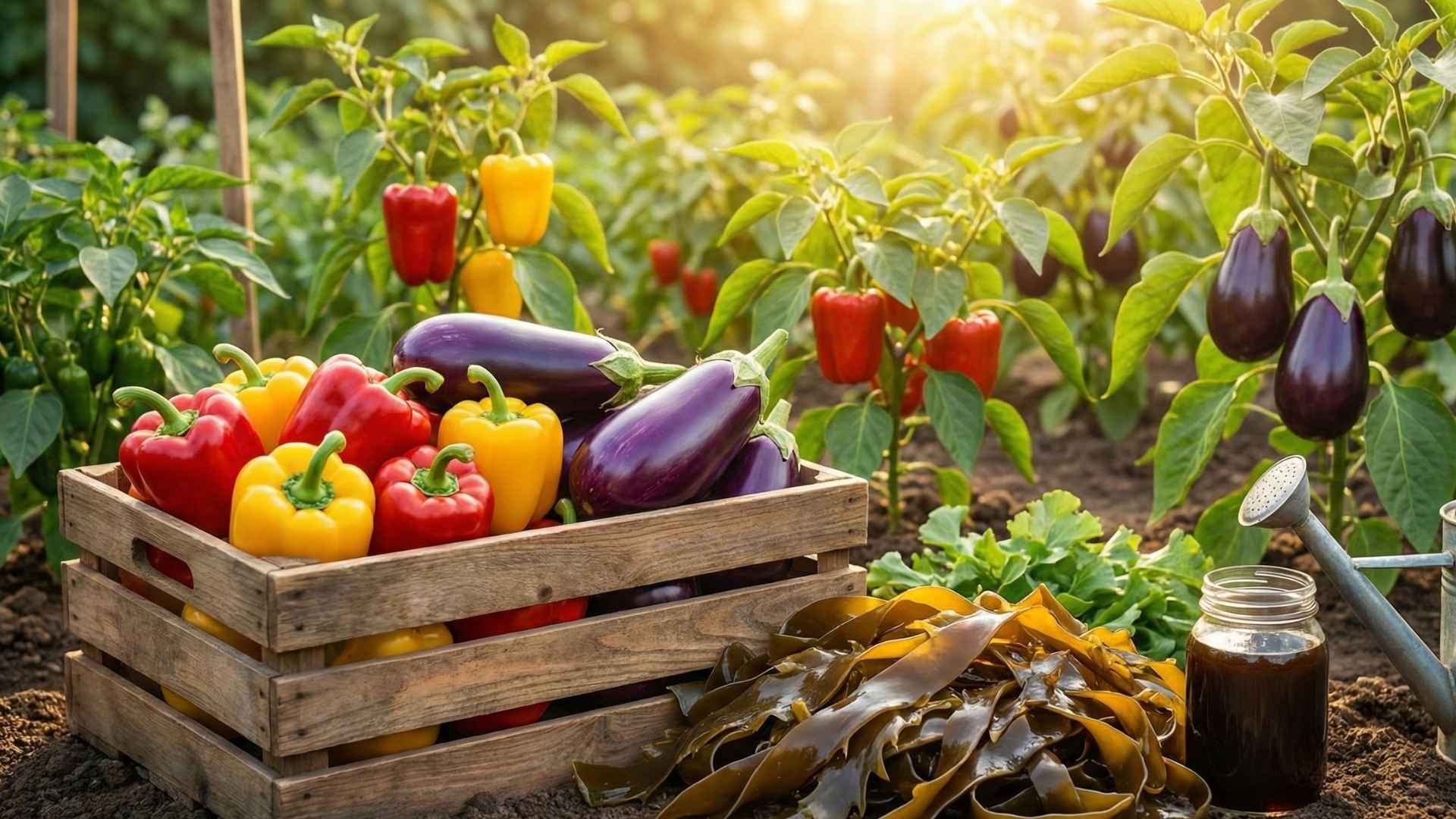
A peer-reviewed scientific study published in January 2025 provides solid evidence: seaweed extracts are a proven tool for improving vegetable performance, particularly in peppers and eggplants grown under real field conditions.
What Did Scientists Actually Study?
The research was conducted by an international team from Bulgaria and Germany (Staykov et al.) and followed a two-year field experiment, not controlled greenhouse pots.
The crops were grown in open soil, exposed to:
- heat waves,
- drought stress,
- natural weather fluctuations.
These are exactly the same challenges home gardeners face every summer.
The study focused on biostimulants derived from the brown seaweed Ascophyllum nodosum, applied to two demanding crops:
- peppers,
- eggplants.
Clear Results That Matter to Gardeners
The findings were consistent across seasons and locations. Compared to untreated plants, vegetables receiving seaweed extract showed:
-
Higher yields
More fruits with greater average weight. -
Stronger stress tolerance
Plants handled heat and water shortages significantly better. -
Improved overall plant condition
Healthier growth and more stable development throughout the season.
For practical gardening, this sends a clear message: seaweed biostimulants are not marketing myths — they are supported by real data.
Why Seaweed Extract Works Differently Than Fertilizers
Seaweed extract from Ascophyllum nodosum does not act like a traditional fertilizer supplying NPK. Instead, it works at a physiological and metabolic level.
Researchers observed changes in plant metabolism linked to:
- improved stress response,
- enhanced nutrient utilization,
- more efficient growth regulation.
In simple terms, seaweed extract helps plants use what they already have more effectively, similar to boosting immunity rather than forcing growth.
Seaweed-Supported Growing vs. Traditional Approach
Tabela: Seaweed biostimulants compared with standard cultivation
| Growing Factor | Standard Cultivation | With Seaweed Extract (A. nodosum) |
|---|---|---|
| Yield size | Typical | Higher (confirmed by research) |
| Drought resistance | Low to moderate | High (improved stress response) |
| Plant vitality | Weather-sensitive | More stable metabolism and growth |
Is Seaweed Extract the Perfect Fertilizer?
Seaweed extract should be understood as a biostimulant, not a complete fertilizer.
It does not replace:
- nitrogen,
- phosphorus,
- potassium.
Instead, it complements them by improving uptake and internal plant efficiency. Compost, manure, or balanced fertilizers remain essential — seaweed simply helps plants make better use of those inputs.
Scientific Source and Credibility
This article is based on a peer-reviewed, open-access scientific publication.
Original title:
Sustainable agriculture through seaweed biostimulants: a two-year study demonstrates yield enhancement in pepper and eggplant
Authors:
Nikola Staykov, Aakansha Kanojia, Rafe Lyall, Valentina Ivanova, Saleh Alseekh, Veselin Petrov, Tsanko Gechev
Published in:
Frontiers / PubMed Central (2025)
License:
CC BY (Creative Commons Attribution)
Source:
https://pmc.ncbi.nlm.nih.gov/articles/PMC12450877/
FAQ – Seaweed Fertilizers in Vegetable Gardening
1. Is every seaweed fertilizer the same as in the study?
No. The best results come from products containing Ascophyllum nodosum. Always check the ingredient list.
2. Can seaweed extract be used on other vegetables?
Yes. Although the study focused on peppers and eggplants, tomatoes, cucumbers, strawberries, and many other crops respond very well.
3. Is seaweed extract natural and safe?
Yes. It is plant-based, environmentally friendly, and safe for pollinators, animals, and humans.
4. When should seaweed extract be applied?
Start after transplanting seedlings and repeat every 10–14 days during active growth.
5. Does seaweed replace standard fertilization?
No. It enhances plant performance but does not replace NPK nutrition.
6. Can seaweed products damage plants if overused?
They are gentle, but dosage recommendations should always be followed.
7. Was the study independent?
Yes. The authors declared no conflict of interest, and the research was publicly funded.
8. Where can gardeners buy seaweed extract?
Look for products labeled “seaweed extract” or explicitly listing Ascophyllum nodosum.
9. Will seaweed help during drought?
It improves tolerance to water stress but does not replace proper irrigation.
10. Is seaweed worth using in small gardens?
Absolutely. The improved plant health and yield easily justify its use even on a small scale.
Discussion (0)
No comments yet. Be the first to start the conversation!
Leave a Reply